The Orthodox Church,
clearly explored.
The Eastern Orthodox Church is a worldwide communion rooted in the apostolic faith, centered on Jesus Christ, and lived through Scripture, worship, the sacraments, prayer, and parish life.
What is the
Orthodox Church?
Orthodox Christianity understands the Church as the historic, worshipping Body of Christ: one faith received from the apostles and expressed through local churches united in doctrine, sacraments, and communion. “Eastern Orthodox” distinguishes this communion historically; it does not describe a separate religion from Christianity.
These source-linked guides explain beliefs and practices, but online reading cannot replace worship, sacramental life, or conversation with a canonical Orthodox priest.
A clear first map of Orthodox Christianity
Start with the center of the faith before moving into individual questions or comparisons.
What Is Eastern Orthodox Christianity?
Eastern Orthodox Christianity is the ancient, apostolic Christian faith lived in a worldwide communion of local churches. It confesses the Holy Trinity and Jesus Christ as fully God and fully human, receives Scripture within Holy Tradition, and centers its life on prayer, repentance, and the Eucharist.
Read the guide 02 the-churchIs the Orthodox Church the Original Christian Church?
The Orthodox Church understands itself as the historical continuation of the one Church founded by Christ, manifested at Pentecost, and led by the apostles. It does not claim that every later custom existed unchanged in the first century. Its claim is continuity of apostolic faith, episcopal and sacramental life, conciliar doctrine, worship, and communion through history.
Read the guide 03 salvationWhat Is Theosis?
Theosis is the human person’s real participation in God’s life by grace—becoming united to God and transformed into Christ’s likeness without becoming God by nature. It is the purpose of creation and salvation: communion, holiness, and love through the Holy Spirit.
Read the guideScripture, saints, Mary, icons, and salvation
Each guide answers the actual objection respectfully, then points to Scripture, history, and Orthodox teaching.
Do Orthodox Christians believe in “Bible alone”?
Clarify the relationship between Scripture and Holy Tradition so seekers understand Orthodox authority and unity.
Read the guide 02 saintsWhy Do Orthodox Christians Pray to Saints?
Orthodox Christians ask saints to pray for them because the saints are alive in Christ and the Church is one communion across death. This intercession does not replace prayer to God or make saints sources of grace. God alone saves; the saints pray as glorified members of Christ’s Body.
Read the guide 03 maryWhy Do Orthodox Christians Honor Mary?
Orthodox Christians honor Mary as Theotokos—Mother of God—because the child she bore is one Person, Jesus Christ, truly God and truly human. She is the foremost saint and a model of faithful human response. She is venerated and asked to intercede, but she is never worshipped as divine.
Read the guide 04 iconsWhy Do Orthodox Christians Use Icons?
Orthodox Christians use icons because the invisible Son of God truly became visible and human in Jesus Christ. Icons bear witness to the Incarnation and the communion of saints. They are venerated with honor, while worship belongs to God alone; the honor shown to an image passes to the person depicted.
Read the guide 05 salvationAre Orthodox Christians Saved by Faith or Works?
Orthodox Christians are saved by the grace of God through a living faith that works through love. Good works do not purchase grace or put God in debt; they are the Spirit-enabled fruit of communion with Christ. Orthodoxy therefore refuses to separate trust in Christ from repentance, obedience, mercy, sacraments, and transformation.
Read the guideWhat Orthodox Christians receive and practice
Explore worship and the mysteries as parts of one life in Christ, not isolated religious customs.
Do Orthodox Christians Believe the Eucharist Is Really Christ’s Body and Blood?
Yes. The Orthodox Church receives the consecrated bread and wine as the true Body and Blood of Jesus Christ, given by the Holy Spirit for communion, forgiveness, healing, and eternal life. Orthodoxy does not reduce the Eucharist to a mental reminder, nor does it claim to explain the mystery completely through one philosophical mechanism.
Read the guide 02 sacramentsWhat Is Orthodox Confession and How Do I Prepare?
In Orthodox confession, a person confesses sins to God in the presence of a priest, who serves as witness, pastor, and sacramental minister of Christ’s forgiveness. Preparation means honest repentance—not producing a perfect list—and a real intention to turn, repair harm where possible, and receive guidance.
Read the guide 03 sacramentsWhy do Orthodox baptize infants?
Explain the Church’s practice so families understand baptism as entry into the covenant community and participation in Christ.
Read the guide 04 worshipWhat to Expect at Your First Orthodox Liturgy
You are welcome to attend an Orthodox Divine Liturgy. Dress modestly, arrive a little early, stand or sit as you are able, and feel free simply to observe. Do not receive Holy Communion unless you are an Orthodox Christian prepared to receive; local customs around blessed bread and other gestures can be learned by asking.
Read the guideOrthodox, Protestant, and Catholic
Begin with what each tradition actually teaches, identify real agreements and differences, then follow the deeper questions.
What does becoming Orthodox actually involve?
Visit a parish, meet a priest, learn patiently, and let the Church guide the pace. The journey is personal, but you do not have to navigate it alone.
Explore the path into the ChurchLet learning become a daily rhythm.
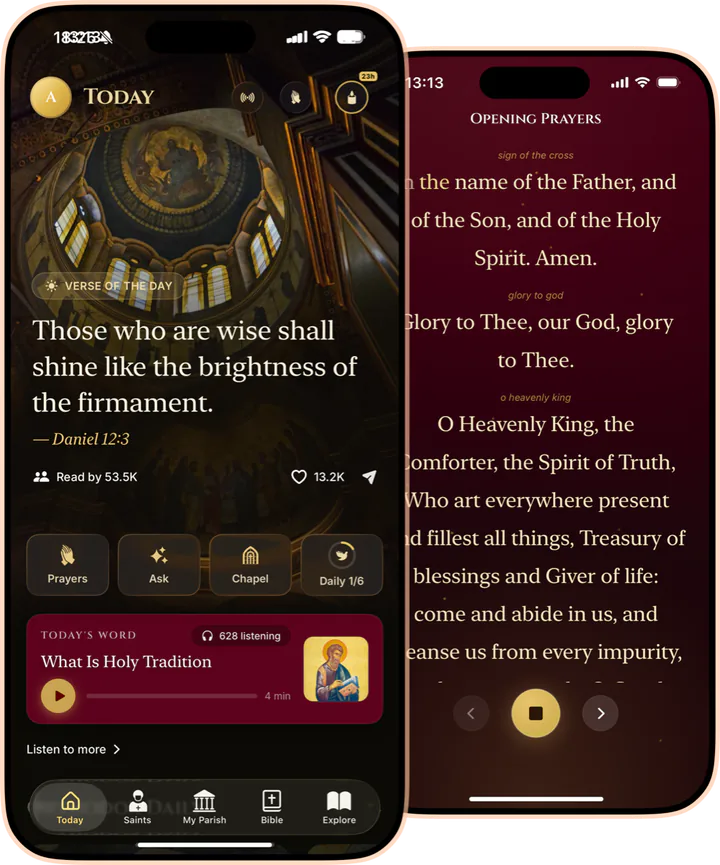
Carry Orthodox Scripture, prayer, saints, daily readings, and guided learning with you—always in service of a real life in the Church.